
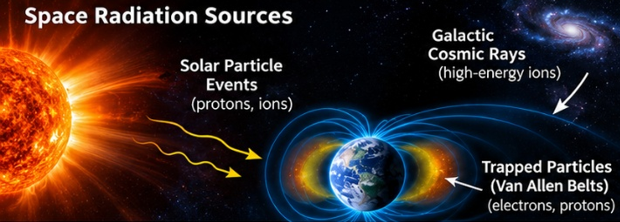
Space electronics are exposed to ionizing radiation and energetic particles from solar events, galactic cosmic rays, trapped particles in Earth’s Van Allen belts, and potentially high-altitude nuclear explosions. A loss of 20% of operating satellites is predicted from long term radiation effects and Kessler syndrome (1) and most satellites eventually will be lost to radiation failures. Satellites can suffer:
- anomalies, which are temporary or recoverable spacecraft malfunctions, resets, bit flips, and instrument interruptions;
- degradation with progressive deterioration of solar cells, detectors, and electronic components; and
- failures, which are permanent component damage or loss of spacecraft functionality.
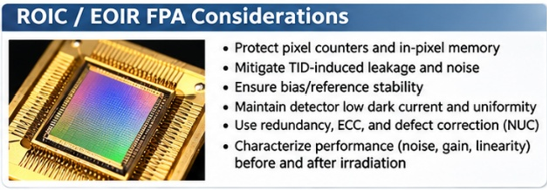
For EO/IR imaging systems, radiation tolerance is particularly important because the readout integrated circuit (ROIC) directly interfaces with sensitive detector arrays. Radiation-induced degradation can increase noise, create defective pixels, affect detector bias stability, and compromise image quality and reliability.
Radiation Effects
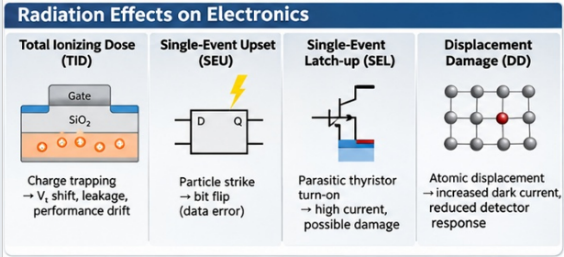
There are many radiation effects:
- Total Ionizing Dose (TID) causes charge trapping in semiconductor oxides, resulting in transistor threshold-voltage shifts, increased leakage currents, and higher electronic noise;
- Single-Event Upset (SEU) from energetic particles generating charge in sensitive semiconductor regions, potentially flipping bits in memory, registers, ADC, and digital pixel counters;
- Single-Event Latch-up (SEL) where a parasitic thyristor circuit can turn on, resulting in excessive supply current and potentially causing permanent chip damage; and finally
- Displacement Damage (DD) from energetic particles displace atoms within semiconductor materials, degrading detector performance through increased dark current and reduced responsivity.
Specifically, for EO/IR sensors, radiation can increase detector dark current, generate hot pixels, increase fixed-pattern noise, reduce detector responsivity, corrupt pixel counters, and degrade image uniformity.
Radiation Hardening Methodologies
SAAZ Micro has extensive expertise and experience in radiation hardening methodologies for electronics and readout integrated circuits (ROIC). We typically use two complementary approaches: Radiation Hardening by Process (RHBP) and Radiation Hardening by Design (RHBD). Also, advanced CMOS processes offer smaller sensitive volumes where less induced charge is deposited, but radiation tolerance must be characterized for each process.
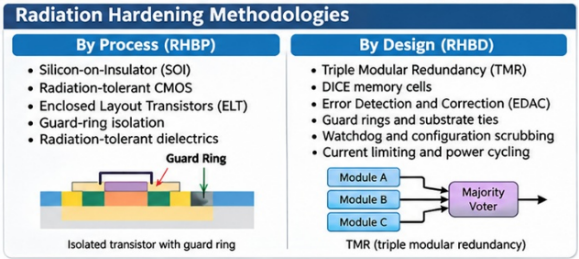
- Radiation Hardening by Process improves radiation tolerance through CMOS process and specialized transistor structures. Silicon-on-Insulator (SOI) and Fully Depleted (FD) CMOS technologies reduce charge collection and susceptibility to latch-up. Radiation-tolerant CMOS processes and optimized dielectric structures minimize radiation-induced degradation. Enclosed Layout Transistors (ELT) reduce leakage caused by trapped oxide charge, while guard rings and substrate isolation limit unwanted charge collection and parasitic current paths. Radiation-tolerant memory and logic structures further improve circuit reliability.
- Radiation Hardening by Design improves radiation tolerance through circuit architecture, layout, and system-level techniques. Triple Modular Redundancy (TMR) protects critical digital logic by using redundant circuits and majority voting. Dual Interlocked Storage Cell (DICE) memory cells improve immunity to Single-Event Upsets (SEU), while Error Detection and Correction (EDAC/ECC) detects and corrects corrupted data. Guard rings and appropriate transistor geometries reduce radiation sensitivity and latch-up susceptibility. Watchdog timers and configuration scrubbing enable fault detection and recovery, while current limiting and automatic power cycling help prevent permanent damage from Single-Event Latch-up (SEL).
Specific ROIC and EO/IR Sensor Considerations
Radiation-hardening strategies for ROICs and EO/IR sensors must address both analog and digital circuitry to ensure reliable operation in space radiation environments.
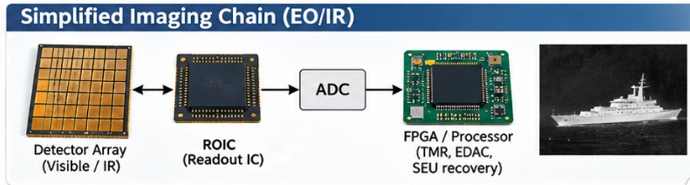
- For CTIA, DI, and BDI pixel circuits, radiation-tolerant devices and adequate bias margins should be used to minimize radiation-induced degradation.
- Low-noise amplifiers should be characterized for noise, gain, and leakage variations before and after radiation exposure.
- Bias and reference circuits should incorporate redundancy and programmable trimming to compensate for radiation-induced parameter shifts.
- Pixel counters and memory should use radiation-tolerant architectures such as DICE cells, Triple Modular Redundancy (TMR), and Error Correction Codes (ECC) to mitigate single-event errors.
- ADCs and timing logic should incorporate Single-Event Upsets (SEU) filtering and error-detection mechanisms to prevent transient disturbances from corrupting image data.
- For detector arrays, dark-current monitoring, Non-Uniformity Correction (NUC), and defective-pixel correction should be implemented to compensate for radiation-induced degradation.
- Finally, detector displacement damage must be evaluated independently of ROIC radiation tolerance, since detector materials and semiconductor readout circuits can exhibit significantly different radiation sensitivities.
Radiation Qualification
Radiation qualification should be tailored to the actual mission orbit, shielding configuration, and expected mission lifetime to ensure that electronic components meet the required radiation tolerance.
- Total Ionizing Dose (TID) testing uses gamma-ray or X-ray irradiation to evaluate radiation-induced parameter degradation.
- Single-Event Effects (SEE) testing uses heavy ions and protons to assess susceptibility to Single-Event Upsets (SEU), Single-Event Transients (SET), and Single-Event Latch-up (SEL).
- Displacement damage testing uses proton or electron irradiation to evaluate degradation in detector materials.
- Functional verification should be performed before and after irradiation to measure key ROIC parameters, including noise, gain, linearity, full-well capacity, frame rate, and pixel integrity. Testing should be conducted under representative operating temperatures, supply voltages, and bias conditions.
For next-generation spaceborne ROICs, a combined Radiation Hardening by Process (RHBP) and Radiation Hardening by Design (RHBD) approach is recommended to maximize radiation tolerance while maintaining imaging performance, reliability, and power efficiency.
Note: Radiation qualification limits (krad (Si), LET, particle fluence) should be established from the specific mission radiation model and required design margin, not as universal ROIC requirements.
SAAZ Expertise
At SAAZ Micro we are evaluating and selecting CMOS process nodes based on measured Total Ionizing Dose (TID) and Single-Event Effects (SEE) performance.
- We incorporate radiation-hardening techniques early in the ROIC design and physical layout to minimize radiation sensitivity.
- We implement redundancy, error detection, and autonomous recovery mechanisms to improve system reliability.
- We characterize detector and ROIC radiation performance independently to identify technology-specific vulnerabilities.
- Finally, we perform radiation testing and qualification as part of our development cycle to ensure that the complete imaging system meets mission-specific radiation requirements.
(1) Kessler Syndrome occurs when space debris in Low Earth Orbit (LEO) becomes so dense that collisions trigger a cascading increase in debris. This threatens satellites, space missions, and the International Space Station, potentially making certain orbital regions unusable and compromising the long-term sustainability of space activities.
References and technical resources